
Planning for Multilingual Learners in Math,
Part 2
by Vanessa Figueroa and Peter Tierney-Fife
There are two broad considerations when planning support for the English language development (ELD) of students who are multilingual learners (MLs) within general education mathematics lessons in the United States. As we wrote about in Part 1 of this blog series, the first consideration is to understand and articulate mathematics language expectations for your students. Second—and the focus of Part 2 in this post—is to determine whether and how to adapt an individual lesson so your students meet those language expectations along with the associated mathematics content objectives. A language-focused version of the Math for All lesson adaptation process can act as a springboard for the co-development of language and mathematics.
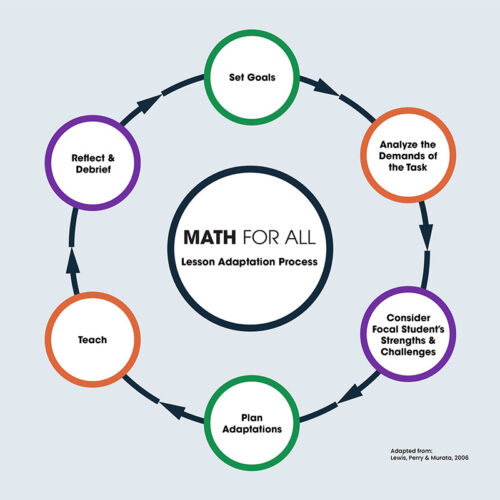
This language-focused process helps you select adaptations that (1) move your student(s) who are MLs toward success with their current language expectations and (2) are likely to support students in meeting the linguistic and mathematics content demands of the individual lesson.
Process for Planning Adaptations
The following four questions outline this process for selecting language adaptations for a specific mathematics lesson. The first step was the focus of Part 1 of this blog series.
- How do the mathematical language expectations for my students who are MLs connect with this lesson? What key language uses (i.e., narrate, inform, explain, or argue) should they demonstrate during the lesson? How will I know they are successful?
- IN PRACTICE
- The language expectations for your grade 5 mathematics lesson are related to WIDA English Language Development (ELD) Standard 3 about constructing mathematical explanations that incorporate describing their steps when solving a problem (WIDA, n.d., p 118):
- Students will accurately use our mathematical vocabulary words
- Success will look like students using these words appropriately in written explanations.
- What are the language demands in this specific lesson, particularly demands that seem most likely to hinder ML students’ success with the mathematics content objectives? Consider both interpretive and expressive language demands.
- IN PRACTICE
- Building on the example above, perhaps the lesson requires that your students:
-
- Understand the problem text and directions
- Communicate while they work on the problem; possibly working with a partner and/or asking for help
- Listen to and understand other students’ explanations during whole-class discussion; some students will say their explanations out loud
- Write their explanation in English on their own papers and include the mathematical vocabulary words volume and dimension and the sequence words first, next, and finally
- Although these language demands indicate places in the lesson to consider scaffolds, perhaps one or two may seem more difficult for one or more of your students who are MLs. Focus first and most on what you think will be the critical language demands for your students.
- What are my MLs’ assets that could help them be successful with these demands? We encourage you to consider primarily on strengths and assets as potential ways to bolster areas of challenge. Math for All professional learning focuses on understanding and considering strengths related to students’ neurodevelopmental profiles. Everyone has a different profile, and an individual student’s assets will change as they learn and grow, so observing students and reflecting on their profiles over time can hone your planning process. Additionally, consider your students’ full linguistic repertoires (English and additional languages, including all language varieties, dialects, and registers); their personal experiences; and their cultural backgrounds.
- IN PRACTICE
- For example, perhaps you have a student who has one or more of the following characteristics:
- Has motor strengths and enjoys movement and using physical manipulatives
- Has social strengths and works well with partners
- Does well organizing work on paper and when using visual representations
- Speaks Spanish and likes to make connections between Spanish and English words
- Loves their dog and helps care for it
- Writes more when working on writing with classmates
- What adaptation(s) to the lesson will build on my student’s strengths to help them have success with the critical language demand(s) of the lesson? Related questions include the following: What has worked for this student in the past and also might be helpful in this lesson? Does my curriculum have suggestions for specific supports for MLs that align with my student’s strengths and the language expectations?
- IN PRACTICE
- The example adaptations below align with the student characteristics above:
- Use hand gestures for the vocabulary and sequence words (possibly the American Sign Language [ASL ] hand gesture for first).
- Use connecting cubes or other physical manipulatives to support thinking about volume.
- Have student partners create and rehearse a shared explanation; encourage them to use their home languages and translanguaging.
- Use meaningful dual coding; use visual representations that build volume up from the area of a base.
- Use a vocabulary anchor chart that includes English and Spanish words together, for example explicitly pointing out cognates for area (área), dimension (dimensión), and finally (finalmente).
- Use a familiar context to practice saying and writing sequence words, such as feeding a dog (e.g., First, I get the bag of dog food. Next, I get the bowl. After that, I pour dog food in the bowl. Finally, I put the bowl on the floor.).
- Use the Stronger and Clearer Each Time mathematical language routine to provide students a chance to revise their explanations in a written format using a successive peer review process.
- We created an editable handout (and a PDF) that has an example word problem and an organizer that can be used during a Stronger and Clearer Each Time routine. The handout also has a word bank and an image that might support students’ understanding of the problem’s context

Considerations for Selecting Adaptations
The adaptation ideas noted above each incorporate one or more of five high-level considerations we believe are important for adaptations that support ELD for MLs during mathematics instruction. Although not listed explicitly below, it is imperative that all your students, including your students who are MLs, are working on rigorous mathematics within a classroom culture that has high expectations for mathematical learning. Your choice of adaptations can be guided in part by these considerations:
- Assets-based: Choose adaptations based on positive information about your students who are MLs and that promote a sense of belonging and agency. An assets-based approach for students who are MLs in mathematics classrooms includes multiple aspects, such as:
- Student centered: Make decisions to best support the students you have in front of you. Incorporate your MLs’ knowledge from prior experiences. Ask probing questions to better understand individual student’s thinking. Provide feedback that is understandable and actionable for individual students and based on their English proficiency level. Use text engineering to increase accessibility for your MLs.
- Funds of knowledge: Consider ways to create connections with your MLs’ cultures, families, and communities to enrich learning by using familiar and relevant contexts and resources in your lessons.
- Language positive: Position all languages as assets and resources instead of barriers. Encourage students to use all modes and registers of communication, their home languages, translanguaging, and emergent English. Read the NCSM and TODOS joint statement Positioning Multilingual Learners for Success in Mathematics, which states that the “use of students’ first language is a human right (Skutnabb-Kangas, 2000) and should be promoted in the mathematics classroom” (NCSM, & TODOS, 2021, pp. 1 & 3).
- Mindset: Foster your MLs’ growth mindset so they see themselves as math-capable. Help them develop a “yet” sensibility. Make sure they know you believe they can learn the English and the mathematics you are teaching.
- Proficiency: Foster a classroom environment in which all students support each other and everyone learns and increases proficiency in both English and mathematics, rather than a performance-focused environment that emphasizes comparisons or competition. Help students see each other as “assets” supporting everyone’s learning.
- Multimodal: Prioritize lesson adaptations for your MLs that include and connect multiple representations of information and encourage the use of physical and visual representations when working on and communicating mathematics tasks. This is particularly important during explicit instruction for important vocabulary terms, which should be taught in context with multiple modalities over multiple days. Multimodal approaches can support interpretive language and/or expressive language. Consider, for example, the following:
- Combining language with related images, videos, and other visuals to support vocabulary development (dual coding) and help your MLs understand task contexts and remember important concepts.
- Total physical response (TPR) by associating gestures with concepts; using other gestures (e.g., hand motions for specific words); and acting out vocabulary, problem contexts, and concepts.
- Use of realia, such as real-world “props” and items.
- Multiple pathways for solving a problem, including choices for their approach and tools, to elevate discourse and promote higher-order thinking skills.
- Schematic visual representations that incorporate mathematical relationships in their structure and can be used to solve problems in a variety of contexts, such as number lines, tape/strip diagrams, and area models. (Evidence shows that teaching all students to use visual representations for problem-solving is important.)
- Physical and virtual manipulatives, such as connecting cubes, counters, pattern blocks, and fractions strips.
- Ways to connect representations, such as using teacher think-alouds, analyzing and connecting multiple worked examples for the same problem, and prompting students to look for the same quantities and relationships across different student approaches.
- Expressive: Structure lessons so students use expressive language—speaking as well as writing and representing—daily while doing their mathematics work. Greater emphasis should be placed on expressive language for students with higher English proficiency levels. A recommendation from a summary of research on supporting elementary and middle school students who are MLs in content-area classes is to provide regular, structured opportunities for students to develop written language skills during content instruction. Build opportunities for expressive language in your lessons that are:
- Low stakes.
- Inclusive: Prioritize adaptations for which all students are expected to speak, write, and represent.
- Sufficient: Provide the time and the scaffolds sufficient for your MLs to respond. Example scaffolds to consider include extended wait time, choral reading and response, opportunities for rehearsal of expressive skills with feedback, encouraging the use of written notes and visuals when sharing thinking, access to multiple translation tools, strategic grouping/pairing, differentiated prompts, explicit teacher modeling, sentence starters and frames, word banks, anchor charts, structured dialogue, and repeated practice over time.
- Social: Plan for and support peer interactions that help your MLs make progress toward their mathematical language expectations and have success with the language demands of the lesson content. Of course, also prioritize ways your MLs can build positive relationships with their peers at the same time. Consider the following:
- Mathematical purpose: Social engagement in mathematics class should support co-development of their linguistic and mathematical learning, such as supporting each other’s problem-solving, explaining their approaches, and practicing writing and saying important mathematics vocabulary.
- Format: Choose ways for students to talk with each other that foster interaction, for example, turn and talks, partner work, and think-write-partner share-revise sequences.
- Supports: Provide scaffolds for your MLs’ engagement during peer interactions, such as explicit modeling of expectations for turn and talks or partner work, a graphic organizer with sentence starters for asking and responding to peer questions during problem-solving (e.g., this conversation support card), and building and using co-constructed word banks in small groups as they start a task.
- Routinized: The use of mathematics language routines can provide, over time, familiar frameworks and tools to develop student’s language skills while working on mathematics content. Predictable routines may lower the cognitive demand on working memory during problem-solving. Select routines that:
- Are adaptable across the different lesson formats you use
- Are applicable for a wide variety of mathematics content
- Promote purposeful use of language while learning mathematics
Ideally, some of your language routines will become automatic processes for students as their familiarity with them increases. To aid in students’ familiarity:
- Introduce the Three Reads routine with the teacher modeling it in full using a problem-specific graphic organizer.
- Shift over time to variations, such as the first read being led by the teacher, choral reading for the second read, and student pairs for the third read.
- Eventually have the routine be student-initiated with the use of an optional generic Three Reads graphic organizer or blank paper.
Additional information related to mathematics routines can be found in Principles for the Design of Mathematics Curricula: Promoting Language and Content Development (Stanford University) and on the Fostering Math Practices website.
Conclusion
We encourage you to try this process when determining adaptations for your students who are MLs in your mathematics lessons. We also encourage you to make this process, when possible, a collaborative effort between English as a Second Language/bilingual teachers and mathematics teachers in order to draw on each other’s expertise and build your collective capacity. While considering specific adaptations, prioritize scaffolds that satisfy at least one of these five considerations: assets-based, multimodal, expressive, social (with a mathematical purpose), and routinized. We hope you find this approach helpful and supportive of your students who are MLs, and we wish you and your students joy as you work on language and rigorous mathematics together!
Related Resources & References
Amparo, O. (2025). Bridging language and mathematics: Best practices for multilingual learners. Student Achievement Partners.
Colorín Colorado. (n.d.). Math instruction for ELLs: Resource collection.
Moschkovich, J. N. (2012). Mathematics, the common core, and language: Recommendations for mathematics instruction for ELs aligned with the common core. Stanford University.
Multilingual Learning Toolkit. (2026). Instructional strategies and resources. New Venture Fund.
National Academies of Sciences, Engineering, and Medicine. (2018). English learners in STEM subjects: Transforming classrooms, schools, and lives. National Academies Press.
NCSM, & TODOS). (2021, Fall). Positioning multilingual learners for success in mathematics.
Nikula, J., & Neumayer DePiper, J. (2021). Middle grades mathematics instruction for multilingual learners: Strategies for success. Education Development Center.
Staehr Fenner, D., Snyder, S., & Gregoire-Smith, M. (2024). Categories of scaffolds. SupportEd.
WIDA. (n.d.). ELD standards framework.
WIDA. (2019). WIDA guiding principles of language development. University of Wisconsin-Madison.
The contents of this blog post were developed under a grant from the Department of Education. However, those contents do not necessarily represent the policy of the Department of Education, and you should not assume endorsement by the federal government.
This work is licensed under CC BY-NC-SA 4.0 


Math for All is a professional development program that brings general and special education teachers together to enhance their skills in
planning and adapting mathematics lessons to ensure that all students achieve high-quality learning outcomes in mathematics.


