
Teacher A and Teacher B: Seeing the Possibilities of Universal Design for Learning 3.0
by Nesta Marshall
It can be said that teaching is an art because teachers can be eclectic in shaping and refining their instructional approaches using a variety of research-based strategies, mentor-informed tools, and action-oriented guidelines. One noteworthy set of guidelines is Universal Design for Learning (UDL). The guidelines support teachers in incorporating the UDL concepts into their practices while also offering viable ways for teachers to support learners. UDL 3.0 is the current iteration of the guidelines and is filled with value-laden principles and meritorious themes for promoting student learning and student efficacy. The guidelines were updated in response to the robust appeal from educators and researchers to “address critical barriers rooted in biases and systems of exclusion for learners with and without disabilities” (CAST, 2024).
UDL 3.0 centers around three big considerations when designing instruction: multiple ways for engagement, multiple means of representing information, and multiple ways for all to interact and communicate (see the graphic below). The guidelines embody the notion that instruction and its delivery, curriculum, information resources, technological devices, assessment and the learning environment, including physical spaces, allow students to have equal access to learning.
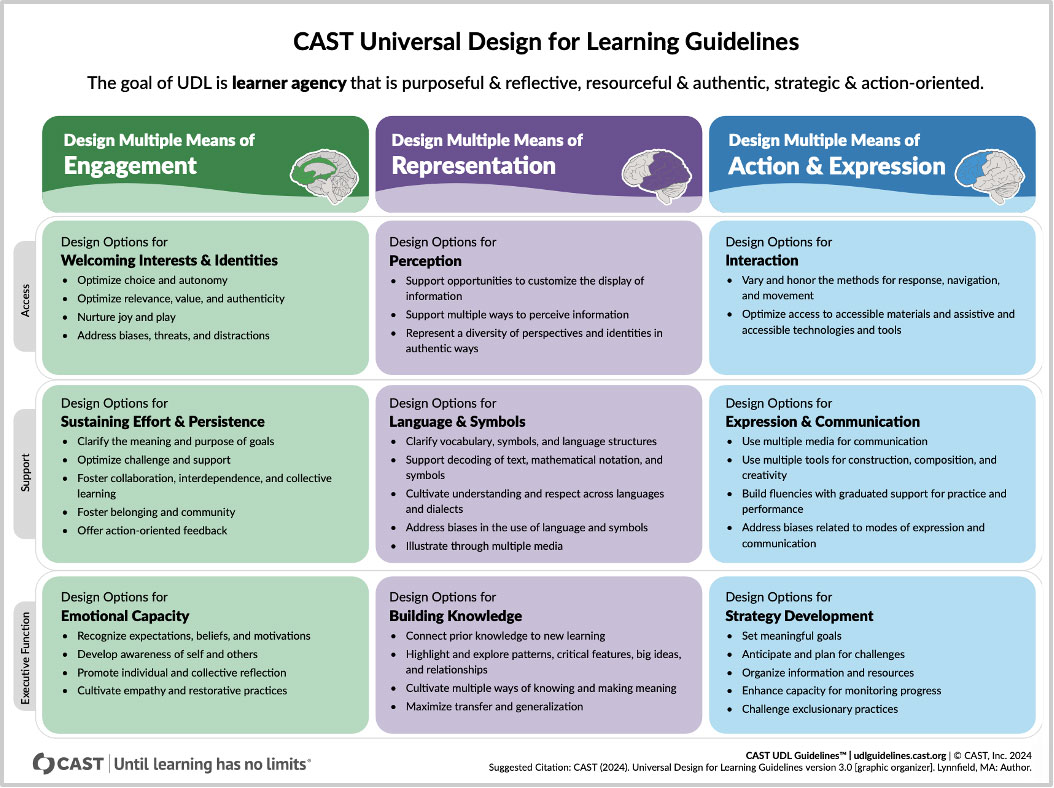
In this blog post, we present two themes for enhancing teaching practices and creating a learning milieu that supports greater learner accessibility to and ownership of math tasks.
Theme 1: Promoting Interdependence and Collective Learning
This theme, as described on the University of Colorado Denver’s Teaching & Innovation blog, notes that the new UDL guideline “emphasizes the value of collective learning and interdependence, encouraging environments where collaboration and shared knowledge-building are central to the learning process.”
One can posit that a classroom environment where collaborative discourse and co-constructing knowledge are promoted does not exist in a vacuum. The learning milieu must espouse a sense of belonging that spans the range of students’ learning capacities, including low-floor and high-ceiling engagement. Of equal import, the classroom community should be a place where culturally sustaining math teaching is esteemed. Moreover, multilingual learners should have “supported opportunities to express themselves” in English and their home language.
Theme 2: From “Expert Learner” to “Learner Agency”
The goal is to shift from elevating “expert learners” to fostering “learner agency,” which centers on developing learners who can actively co-create their learning environments.
This theme is tied strongly to recognizing students’ assets and optimizing student learning by promoting multiple approaches toward sensemaking. This can be achieved by looking at a student at work, promoting the use of manipulatives, and having resources available to support challenges. In this type of strengths-based classroom, opportunities for creativity, rigor, equity, student autonomy, and self-advocacy position students to have a voice and a choice in their learning. As Hammond (2025) notes in her article, agency can be developed when teachers integrate a “cognitive apprenticeship” model, support student examination and revision of how they see themselves as learners, and offer regular opportunities for student reflection.
Keeping these two UDL themes in mind, let’s take a look at two different classrooms with two different teachers: Teacher A and Teacher B.
Teacher A
In Teacher A’s grade 6 classroom, 24 students are deepening their understanding of the Cartesian coordinate plane by plotting points across all four quadrants. After reviewing the coordinate plane and explaining how to plot the negative number coordinates, Teacher A gives directions for students to plot sets of ordered pairs and then to connect the points to create pictures on their graph papers. Students work individually at their desks with no noticeable on-task dialogue happening among them. Several minutes into the task, a student approaches Teacher A and requests a ruler. The exchange between them is as follows:
Student: Can I have a ruler?
Teacher A: Why do you need a ruler?
Student: I need one to do the picture.
Teacher A: I don’t see why you need a ruler. Everyone is doing it without a ruler.
Student: I’m not everyone.
Reluctantly, Teacher A hands the student a ruler from her desk drawer, but she remains at her desk. Just before the class dismissal, she asks for volunteers to show the pictures that they created.
Teacher B
In Teacher B’s sixth-grade classroom, 24 students are doing the same task as those in Teacher A’s class. However, there are clusters of four desks. Math manipulatives and tools (e.g., geoboards, rubberbands, rulers of varied lengths, and colored pencils) are easily accessible. Teacher B also has options for the coordinate grid (e.g., varied-sized graph paper, a pre-printed grid with a plastic sleeve for dry-erase purposes, a large, laminated grid, and digital grids). An active word wall with lesson-specific vocabulary (i.e., origin, ordered pair, x-axis, y-axis, x-coordinate, y-coordinate, quadrant, coordinate plane, and integer) and correlating pictures and examples are provided. Additionally, student-created glossaries in English and their dominant language are available. After an interactive mini-lesson, students are given a menu of tasks that consists of the following:
- Writing the ordered pair for 6 out of 8 points
- Choosing 6 out of 8 ordered pairs to plot and label
- Creating shapes or objects using a set of points provided or their own points
- Making a map and labelling the points to show the location of at least five items in a place that they chose
Two students request to review a short video demonstration on plotting points, which Teacher B grants and commends them on.
At the back of the classroom, a small group of students creates a coordinate grid using the floor tiles. They take turns calling out a point and positioning themselves to represent its location. Jack and Bella compare how they each plotted (-3, 2), and Bella realizes that she moved three units down from the origin and then jumped two across to the right. Jack explains that the first number in the ordered pair is located on the horizontal number line. Another student, Jamie, listening in on their conversation, recognizes that he used the correct directions for the (x, y) on the geoboard, but thought that the origin started with the number 1. So his point is (-4, 3).
As Teacher B circulates, she asks all three students how they might remember where to start and which direction to go next time. Jack shows her the arrows that he used to recall the direction (-3←, 2↑). Jamie shares an idea for a rap: “To the right and climb up are positive moves; To the left and climb down are negative moves, That’s how we groove and prove.” Teacher B encourages them to add their strategies to the Strategies for Using the Coordinate Plane chart.
As Teacher B continues to circulate, she sees Malachi and Gus drawing a rocket ship on a large, laminated coordinate plane. While looking at where the corners of the rocket ship’s engine land on the grid, Malachi and Gus comment that the repetition of numbers in the ordered pairs (-5, 1; -5, -1; 5, 1; 5, -1) is “cool.” Teacher B probes: “What do you notice? What patterns do you see? Does the pattern work for other sets of ordered pairs? When does the pattern work? Can you make a rule?”
For the lesson’s closure, Teacher B asks several questions: “What was important to know about the ordered pairs and why? If given this task again, what would you do the same or differently? What new idea or strategy did you discover? Where might labelling points be useful?”
Clearly, the examples of Teacher A and Teacher B illustrate two teachers, two classes, and two different instructional approaches. Using Teacher A’s story as a counterpoint and something to ponder (including the ruler episode), let’s unpack how Teacher B integrated the two UDL themes into her practices.
Interdependence and Collective Learning |
Learner Agency |
|
|
|
|
|
|
|
|
At any given time, an educator can intentionally, unexpectedly, or unwittingly mirror Teacher A’s instructional practices. If this is your case, a good place to start could be to learn from Teacher B (who is Teacher A reimagined). Consider the maximal positive impact that such a strategic, student-empowered, resource-rich, collaborative-focused instructional approach would yield. Let’s then avail ourselves of the teacher-ready resources, such as UDL 3.0, that would arm our students with their metaphorical “ruler” and help us to create a learning environment that engenders productive learning outcomes in our students’ lives in the classroom and beyond.
References
CAST. (2024). Universal design for learning guidelines (Version 3.0). https://udlguidelines.cast.org/
Hammond, Z. (2025, November 9): Rebuilding students’ learning power with learn-to-learn skills. Cult of Pedagogy. https://www.cultofpedagogy.com/learn-to-learn/
Lambert, R. (2024). Rethinking disability and mathematics: A UDL math classroom guide for grades K–8. Corwin Press.
Math for All. (n.d.) Making rich mathematics accessible to all students in grades K–8. https://mathforall.edc.org/
University of Colorado Denver. (2024 Giacomini. J. (2024, September 24). Recently updated! Universal design for learning (UDL) guidelines 3.0: July 2024 update embraces identities and addresses critical barriers to learning. Teaching & Innovation Blog. https://www.ucdenver.edu/tips/resources/blog/TIPS-blog-recently-updated–universal-design-for-learning–udl–guidelines-3-0
The contents of this blog post were developed under a grant from the Department of Education. However, those contents do not necessarily represent the policy of the Department of Education, and you should not assume endorsement by the Federal Government.
This work is licensed under CC BY-NC-SA 4.0 


Math for All is a professional development program that brings general and special education teachers together to enhance their skills in
planning and adapting mathematics lessons to ensure that all students achieve high-quality learning outcomes in mathematics.


